Communication with customers
has grown to be one of the biggest elements of a business's performance. Customers
today expect quick responses to their needs, personal interactions and assistance
through the platforms they use most often. Of all the communication
channels, WhatsApp has emerged as an ideal communication tool for both
consumers and businesses.
As more than 2 billion active
users exist around the world, WhatsApp offers businesses a chance to engage
with their clients through the medium of a convenient environment. However,
with the expansion of the business itself, engaging in conversations with
thousands of clients may become harder for them.
This is the place the WhatsApp Business
API can be found. It
allows businesses to increase the amount of the customer's communication,
streamline interactions and also connect WhatsApp to existing business systems. In
this article we'll look at the details of what WhatsApp Business API is, what
it does with its primary features advantages, as well as why companies are
quickly taking it on.
What Is WhatsApp Business API?
WhatsApp Business API can be
described as an official product created by Meta which allows medium-sized as
well as large-sized businesses to interact with their customers via WhatsApp in
a large size.
Contrary to WhatsApp's
standard Business App, the API is geared towards businesses who require
advanced communications capabilities that include automated messaging,
integration with CRM Multi-Agent Support, as well as high-volume messaging.
The API does not offer a user
interface. It instead connects to different platforms, business software
as well as customer-facing tools which allow companies to handle communications
efficiently.
The API is used by businesses
to: API to:
- Offer customer assistance
- Order updates to send
- Set reminders for
appointments to share.
- Run marketing campaigns
- Automate customer
interaction
- Improve customer
engagement
Why Businesses Are Choosing
WhatsApp
Traditional channels of
communication, such as telephone and email support frequently are plagued by
low engagement as well as delayed response times.
People are increasingly using
messaging as it's quicker easier, more user-friendly, and is accessible from
any location.
The benefits of WhatsApp
communications includes:
- Live-streamed
conversations
- Rates of openness to
messages that are higher
- Better customer
engagement
- Resolution of issues
faster
- Personalized customer
experiences
While expectations of
customers continue to grow and evolve, messaging platforms are now integral to
corporate communication strategies.
WhatsApp Business API vs
WhatsApp Business App
Numerous businesses ask
themselves about whether they should utilize Business App or API. Business App
or the API.
WhatsApp Business App
This WhatsApp Business App is
designed to cater to small and medium-sized companies.
Some of the features are:
- Creation of a business
profile
- Rapid responses
- Catalogues for products
- Basic tools for messaging
While it can be useful for
small teams, it can be problematic for handling huge customer numbers.
WhatsApp Business API
API API is specifically
designed to help grow companies and organizations.
It includes:
- Automation capabilities
- Integration of CRM
- Access to multiple users
- Chatbot assistance
- Scalable messaging
- Advanced analytics
Businesses that deal with
large number of interactions with customers often find that an API better
suited to longer-term expansion.
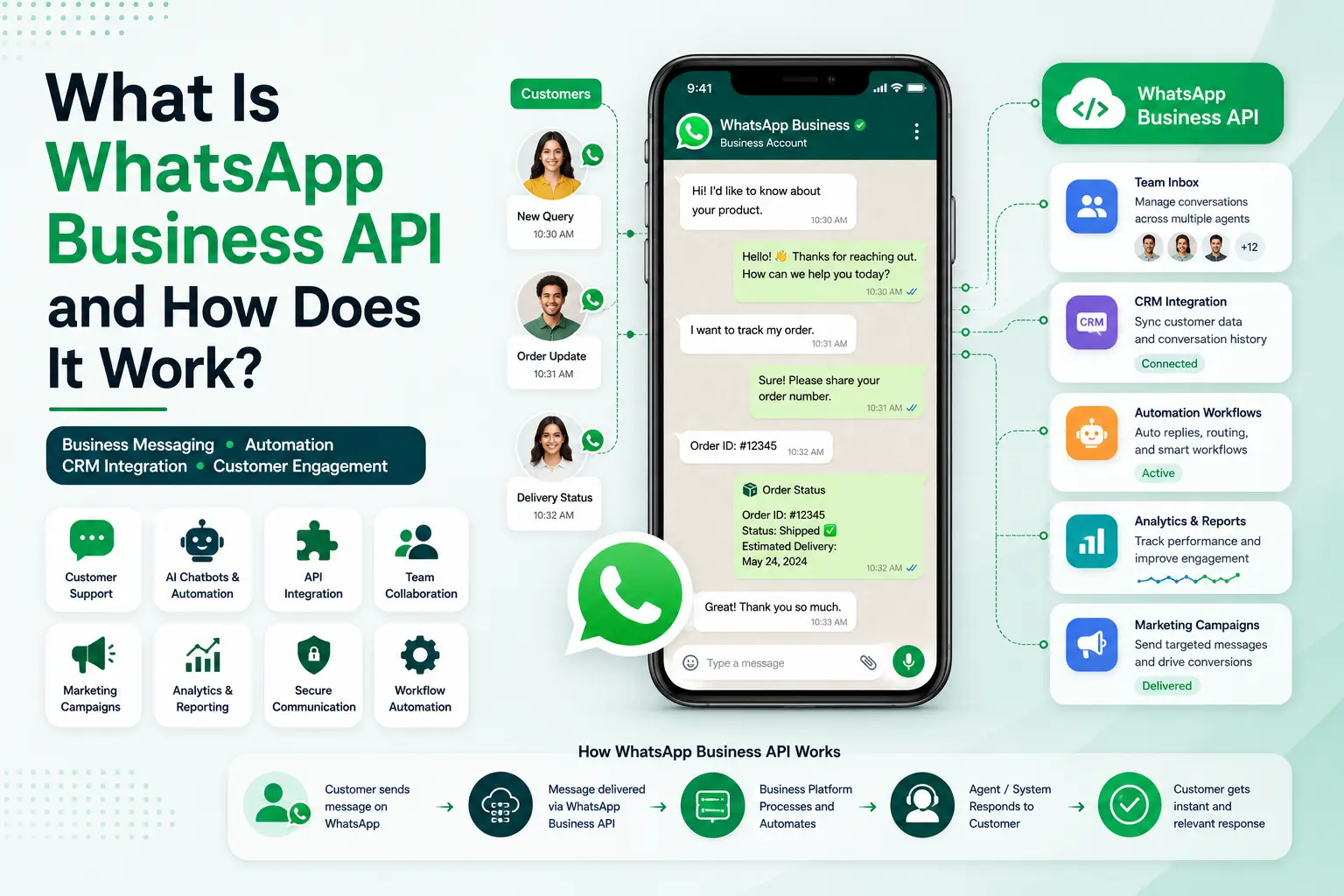
How Does WhatsApp Business API
Work?
API API serves as an
intermediary between WhatsApp and the business's communications system.
A typical workflow appears
similar to this:
Step 1: Customer Sends a
Message
Customers contact the company
via WhatsApp.
Step 2: Message Reaches
Business Platform
The message will be routed via
the API into the communication platform.
Step 3: Automated or Human
Response
The company can react by:
- Customer support agents
- Automated workflows
- AI chatbots
- CRM systems
Step 4: Conversation
Management
Every interaction with
customers is tracked and controlled by linked business software.
This method allows businesses
to manage large volumes of communication quickly.
Key Features of WhatsApp
Business API
The popularity of the WhatsApp
API is driven by its impressive feature set.
Multi-Agent Support
Members of multiple teams can
participate and control customer conversations at the same time.
This enhances cooperation and
effectiveness.
Message Templates
Business can approve template
messages that address:
- Order updates
- Reminders for
appointments
- Notifications of payments
- Campaigns for promotion
Analytics and Reporting
A detailed report helps
companies track:
- Delivery charges
- Response to rates
- Customer engagement
- Campaign performance
Security and Reliability
WhatsApp offers secure
communications through an end-to-end encryption system and a high-quality
infrastructure.
Understanding WhatsApp API
Integration
The main benefit of using the
API is its capability to integrate with enterprise systems.
Many businesses
implement the Whatsapp
API integration for
centralizing customer contact and improve workflow.
Common integrations are:
CRM Systems
Information about customers
can be synced in a way that is automatic.
The most popular CRM
integrations allow agents to get instant access to the history of their
customers.
Helpdesk Platforms
Support teams handle WhatsApp
conversations along with other communications channels.
E-commerce Platforms
Business can automate orders
confirmations delivery notifications, order confirmations, as well as
assistance to customers.
Marketing Tools
The management of campaigns
becomes simpler with the integration of marketing platforms.
These integrations result in
more efficient and integrated customer experience.
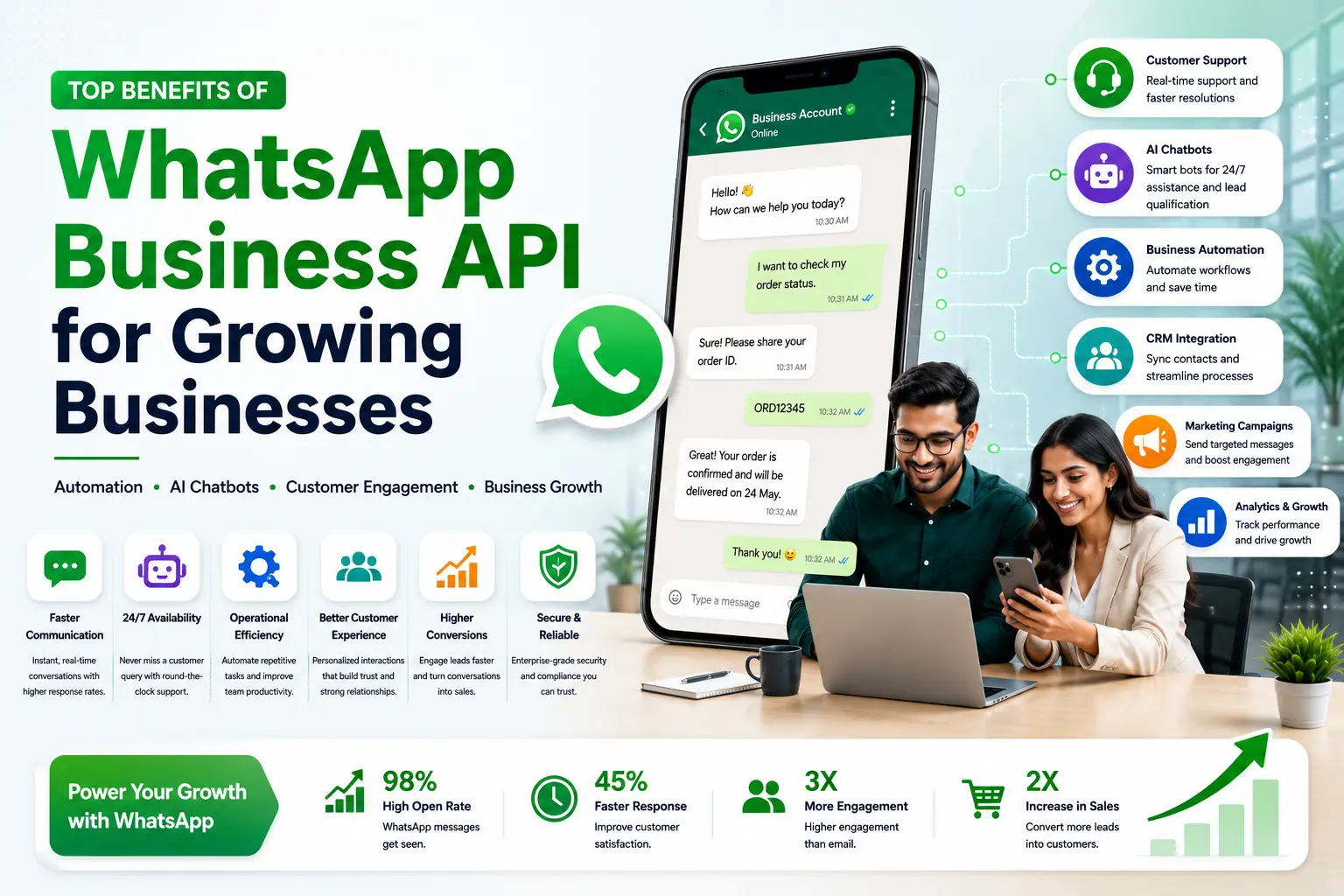
Benefits of WhatsApp Business
API
Companies across all
industries are embracing WhatsApp because of its quantifiable positive effects.
Improved Customer Support
Customers get faster service
and better customer service.
Better Customer Engagement
The use of messaging can
result in greater engagement rates than conventional channels.
Increased Efficiency
Automation can reduce
repetitive tasks and boosts efficiency.
Higher Conversion Rates
Live conversations can help
businesses guide customers through sales funnels better.
Scalability
Organisations are able to
handle hundreds of interactions with customers without substantially increasing
the cost of support.
Role of Automation in WhatsApp
Communication
Automation has become vital
for companies that manage large volumes of communication.
With the help of WhatsApp automation feature businesses
can reduce tedious tasks, while ensuring constant customer service.
Examples include:
- Thank you messages
- Lead qualification
- Reminders for
appointments
- Notifications about
shipping
- Customer feedback
collection
Automated systems help
businesses offer faster services without a huge support team.
WhatsApp as a Business
Messaging Platform
Companies require
communication tools that have a long-lasting, reliable and user-friendly.
A contemporary WhatsApp
business messaging system lets businesses manage conversations
between departments, while ensuring the same user experience.
Some features include:
- Inboxes that are shared
- Collaboration tools for
teams
- Conversation routing
- Analytics of performance
- Automating workflow
They help companies provide
high-quality communication on a large the scale needed.
How Businesses Use WhatsApp
API
Different industries employ
the WhatsApp API in different methods.
E-commerce
- Confirmation of orders
- Delivery tracker
- Product suggestions
Healthcare
- Appointment scheduling
- Patient reminders
- Contact for follow-up
Education
- Student notification
- Updates to the course
- Enrollment assistance
Real Estate
- Lead qualification
- Information about
property
- Booking an appointment
Financial Services
- Notifications about your
account
- Customer support
- Verification of documents
The adaptability of WhatsApp
allows it to be used in almost every field.
Choosing the Right WhatsApp
API Provider
Selecting the correct supplier
is an essential company decision.
A dependable WhatsApp
API provider helps
simplify onboarding integrations, onboarding, as well as ongoing monitoring.
When evaluating providers,
consider:
Scalability
Will the solution evolve in
line with your business?
Support
Do they provide prompt
technical support?
Integration Options
It can be integrated to the
existing stack of software?
Security
Does the platform meet the
privacy and security requirements?
Reporting Features
Do they provide real-time
analytics?
Selecting the right partner
will greatly impact the long-term viability.
How WhatsApp API Supports
Business Growth
As businesses expand and
communication becomes more complex, the difficulty of communicating grows.
Communication complexity.
That's why a lot of companies
are embracing the WhatsApp API for companies which require
scaled solutions for customer engagement.
The benefits include:
- Faster lead response
times
- Better customer retention
- Increased efficiency of
operations
- Stronger customer
relationships
- Increased satisfaction of
customers
Business can keep high-quality
customer service regardless of the increase in customer volume.
Best Practices for Using
WhatsApp Business API
In order to maximize their
results, businesses need to follow these guidelines:
Obtain Customer Consent
Be sure to collect the opt-ins
prior to making any messages.
Personalize Communication
Personalize messages to meet
the needs of customers based on their preferences and their behavior.
Use Automation Strategically
Automate repetitive tasks,
while keeping the human contact.
Monitor Performance
Keep track of key metrics and
constantly improve communications strategies.
Follow WhatsApp Policies
It helps ensure the integrity
of your account and builds trust with customers.
Future of WhatsApp Business
Communication
Business messaging is growing
more sophisticated and automated.
Trends that are emerging
include:
- AI-powered customer
assistance
- Commerce in conversation
- Predictive messages
- Personalization that is
advanced
- Omnichannel customer
interaction
With the advancement of these
technologies, WhatsApp will continue to be a key element in the strategies of
customer communications.
Conclusion
While expectations of
customers continue to increase, companies require technology that is fast as
well as scalable and customer-focused.
WhatsApp
business API offers businesses with
the necessary tools to streamline interactions, boost customer engagement as
well as integrate systems for business and provide exceptional customer
service.
If your focus is on sales, customer
service marketing, operating efficiency, WhatsApp Business API offers the most
powerful platform to modern-day business communications. Companies that
take advantage of messages-driven customer engagement now will have a better
chance of achieving future growth and prosperity.